Nederlands
 Deutschland
 Österreich
 Schweiz
 English
 Français
 Čeština
 Dansk
 Español
 Suomi
 Italiano
 Português
 Svenska
 Polski
 Ireland
 Ελληνικά
 Română
 Magyar
 Eesti
 Български
 Slovenčina
 Slovenščina
 Latviešu
Sustainable Business Practices Using the CSR Performance Ladder
Sustainability is no longer a luxury, but a requirement for staying relevant. Companies must prove that they operate responsibly,...
Read article


These days, there are so many chips on the market that it’s easy to lose track of them all. That’s why we thought it would be a good idea to list all the different types of RFID chips. We’ll then take a look at their features, capabilities, and applications, so you’ll have a clear idea of which RFID chip you need.
Buy RFID tagsRFID is an umbrella term referring to a technology that enables remote communication via RFID chips. RFID encompasses various techniques, such as NFC. The technology is also often regarded as the successor to the barcode. Before purchasing an RFID chip, you should consider its frequency, as these vary. There are several possible frequencies, namely:
These chips operate at 125 KHz and have a range of 2 centimeters to 100 centimeters. With a memory capacity ranging from 64 bits to 1 kB, this chip can be used for access control. The EM 4200 card is an example of a low-frequency chip.
These chips operate at 13.56 MHz and have a range of 10 centimeters to 1 meter. With a memory capacity of up to 2 kB, this chip is often used in registration systems, such as time-clock systems.
These chips operate at frequencies ranging from 860 to 950 MHz and have a range of up to 12 meters. In general, a UHF chip has a range of several meters. The latest version is the UHF Gen2. This chip is currently the most widely used of all UHF chips.
Now that you know what the frequencies mean, let’s take a look at the different types of chips. The 5 most popular RFID chips are:
This RFID chip is the most popular of them all. It operates at a low frequency (13.56 MHz), resulting in a read range between 2 centimeters and 100 centimeters. This chip is competitively priced. We see this chip used frequently in access gates, such as at gyms and ski lifts. Lockers are also often equipped with this chip.
This type is the cheapest of them all. Since this chip cannot be secured, it is often used as a disposable chip.
This variant features special 3DES security. This offers various options for securing the chip. That’s why we often see this chip used in access control systems.
Thanks to its high frequency, this chip can operate over long distances. In addition, the chip offers various security features, making it ideal for access control and safes.
A high frequency means a long read range. This chip can even transmit over distances of up to 12 meters. This makes the chip ideal for toll gates and parking garages, where communication must travel longer distances.
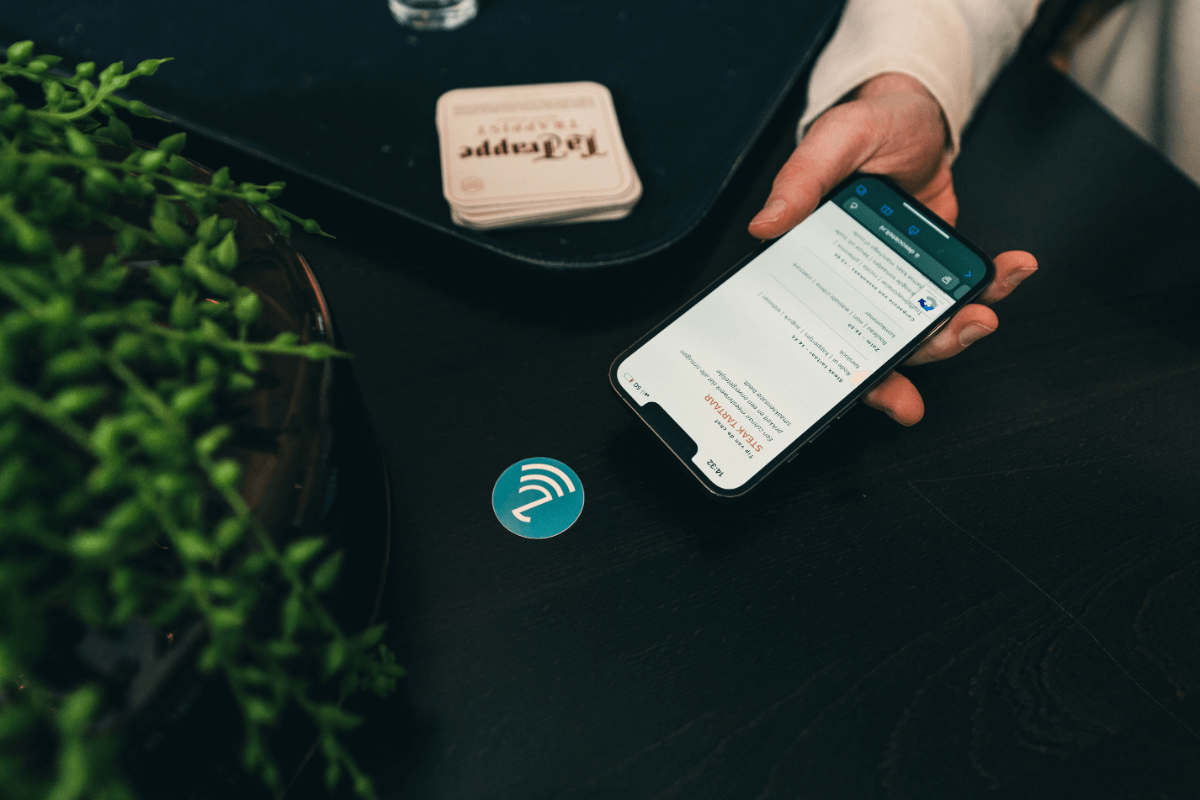
NFC chips can also be classified under the term RFID. The three most commonly used NFC chips are the NTAG213, NTAG215, and NTAG216. The NTAG variants are exactly the same except for their memory capacity.
This is the least expensive option and has 144 bytes of storage capacity.
In terms of storage capacity, this chip falls right between the NTAG213 and the NTAG215. With 444 bytes, it’s often referred to as the “mid-range” option.
This chip has the largest number of bytes in the NTAG series. With a whopping 888 bytes, you can be sure you have enough capacity for any purpose.
In the table below, you can see how many bytes you need for certain operations.
| Website address | 19 bytes |
| Phone number | 16 bytes |
| Email with subject line | 84 bytes |
| Digital business card with all contact information | 153 bytes |
| A trigger (phone on silent) | 76 bytes |
| A trigger (turn on Wi-Fi and launch the app) | 118 bytes |
| A trigger (turn on Wi-Fi, silence the phone, and launch the app) | 122 bytes |
RFID stands for Radio Frequency Identification and is a technology that allows information to be exchanged remotely via RFID chips. These chips are used for various applications, such as access control, registration systems, payment transactions, and product identification. RFID is also seen as the successor to the barcode, because it is faster, more efficient, and more accurate in identifying products and information.
RFID chips operate at different frequencies: Low Frequency (LF) at 125 kHz, High Frequency (HF) at 13.56 MHz, and Ultra High Frequency (UHF) from 860 to 950 MHz. LF chips are primarily used for access control, such as at gyms and lockers. HF chips are often used for registration systems, such as time-clock systems. UHF chips are used for applications that require long-range communication, such as at toll gates and parking garages.
The five most popular RFID chips are MIFARE Classic 1K, MIFARE Ultralight 64 bytes, MIFARE DESFire 125 MHz, EM4200 125 kHz, and UHF RFID. MIFARE Classic 1K is often used for access gates and lockers, MIFARE Ultralight 64 bytes as a disposable chip, MIFARE DESFire 125 MHz for access control, EM4200 125 KHz for access control and lockers, and UHF RFID for toll gates and parking garages.
NFC chips can also fall under the term RFID. The three most commonly used NFC chips are NTAG213, NTAG215, and NTAG216. The NTAG213 is the least expensive option, with 144 bytes of storage. The NTAG215 falls between the NTAG213 and NTAG216 and has 444 bytes of storage. The NTAG216 has the largest storage capacity in the NTAG series, at 888 bytes. The number of bytes required for specific actions can vary; for example, 19 bytes for a web address and 153 bytes for a business card containing all contact information.