Nederlands
 Deutschland
 Österreich
 Schweiz
 English
 Français
 Čeština
 Dansk
 Español
 Suomi
 Italiano
 Português
 Svenska
 Polski
 Ireland
 Ελληνικά
 Română
 Magyar
 Eesti
 Български

Sustainable Business Practices Using the CSR Performance Ladder
Sustainability is no longer a luxury, but a requirement for staying relevant. Companies must prove that they operate responsibly,...
Read article


“RFID vs. NFC” is actually a misnomer. Many people think these technologies are competitors. This is not true. In fact, NFC is a form of RFID. What’s more, they can coexist very well. There’s also a large group of people who think there’s no difference between them. I understand the confusion. NFC is an application of RFID, but it has different characteristics that make them distinctly different from one another. Given the many misconceptions surrounding RFID and NFC, I’ve decided to use this article to clear up all the confusion between the two technologies.
Buy NFC tagsTo get a sense of what’s out there regarding RFID and NFC, I decided to browse the internet. I noticed that the terms are often used interchangeably. This explains the confusion surrounding this topic. Because of this, many people have come to believe that the technologies are the same, but nothing could be further from the truth. They are two different methods of communication, each suited for different purposes.
RFID stands for “Radio-Frequency Identification” and is a technology based on radio waves. Data can be stored in the RFID chip. This data can be read by an RFID reader via radio waves.
There are 3 types of RFID:
NFC is an application of RFID. RFID involves the storage and transmission of data in one direction. But with NFC, it’s different. NFC involves two-way communication. In addition, an NFC chip can process the received signals. In other words, this chip is much more intelligent than a standard RFID chip.
The main differences lie in the range and the method of information exchange. Below, we explain the 4 most important differences.
An RFID tag has a much greater range. The chip can transmit signals up to 8 meters. With an NFC chip, the maximum range is 10 centimeters. This makes both tags unique and suitable for different purposes. NFC is ideal for payments, while RFID is used for gaining access at ski lift gates.
An RFID chip can only be read. This is a one-way process. NFC tags, on the other hand, can both send information and be read. This makes the NFC tag more intelligent than the RFID tag.
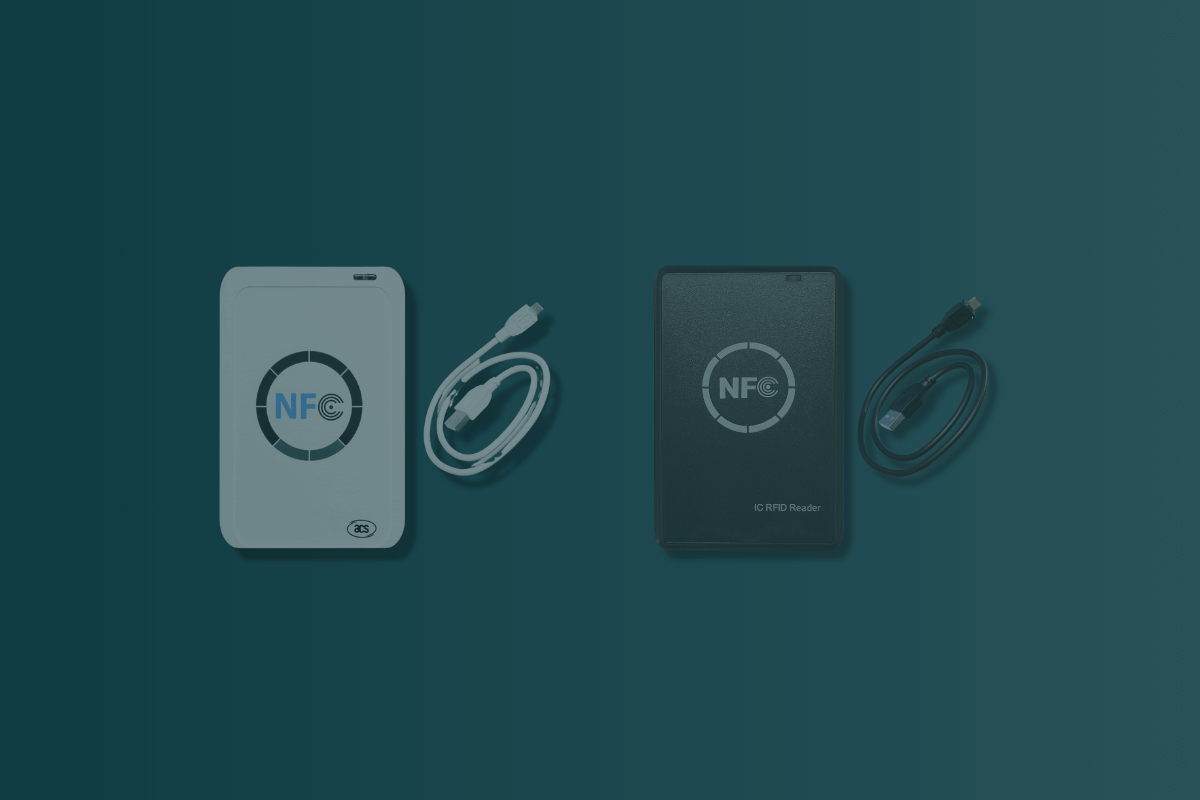
NFC tags can be easily read with a phone. With RFID tags, you need special equipment to do this. This makes NFC much more accessible to consumers.
It is possible to scan multiple RFID tags at the same time. This is not possible with NFC tags. That is why, at Decathlon, we see that products are labeled with RFID tags so that they can all be scanned at once at the checkout. If the products were equipped with NFC tags, each product would have to be scanned one by one.
Buy NFC tagsRFID stands for “Radio-Frequency Identification” and is a technology based on radio waves. An RFID chip can store data, and this data can be read by an RFID reader via radio waves. There are three types of RFID: active RFID (with a power source that transmits signals on its own), semi-active RFID (with a power source that transmits signals as soon as it receives them), and passive RFID (without a power source; it draws power from another device).
NFC is an application of RFID. RFID involves storing and transmitting data in one direction, but NFC works differently. NFC involves two-way communication, and an NFC chip can process incoming signals. This makes the NFC chip more intelligent than a standard RFID chip.
There are four key differences between RFID and NFC. The first difference is range. An RFID tag has a longer range of up to 8 meters, while an NFC tag has a maximum range of 10 centimeters. The second difference is signal capabilities. An RFID chip can only be read, while NFC tags can both send and receive information. The third difference is reading. NFC tags can be easily read with a phone, whereas special equipment is required to read RFID tags. This makes NFC much more accessible to consumers. The fourth difference is scanning. It is possible to scan multiple RFID tags simultaneously, whereas each NFC product must be scanned one at a time.
No, they aren’t. NFC is a form of RFID. They can both coexist and are suitable for different purposes. There are many misconceptions about RFID and NFC, leading people to believe they are the same or that they are competitors. In reality, they are two different methods of communication with distinct characteristics.